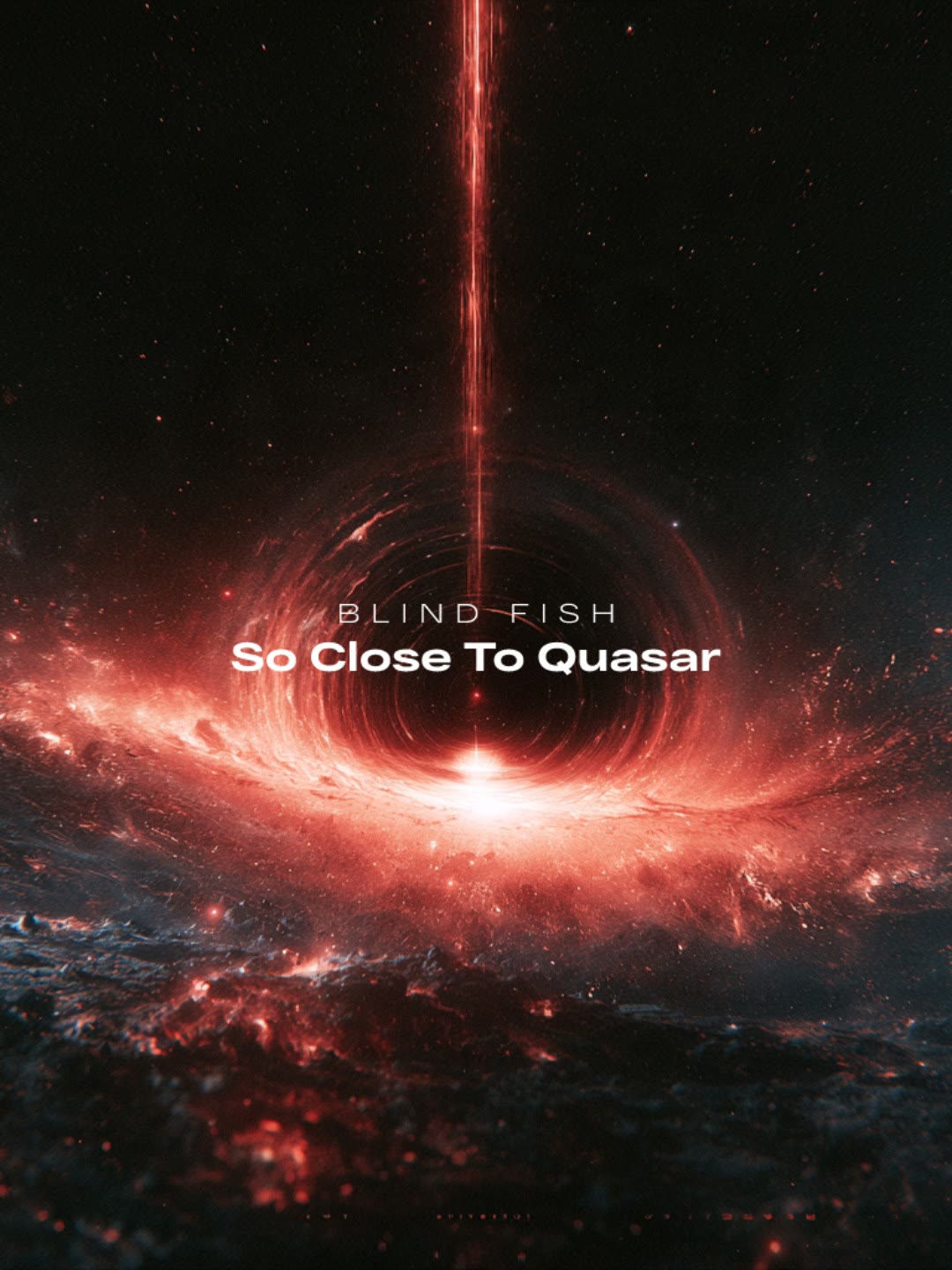
Трек · Эмбиент · Спейс-эмбиент · 4:04
So Close To Quasar

4:04
14 прослушиваний
0 комментариев
AI-разбор песни
87.5БАЛЛОВ ИЗ 100
40-еМЕСТО ИЗ 375
Научная лекция в сердце квазара
Верхняя четверть
В жанре «Эмбиент» — 4-е место из 8 · средний балл жанра 85.2
Место делят 5 песен с тем же баллом
В жанре «Эмбиент» — 4-е место из 8 · средний балл жанра 85.2
Место делят 5 песен с тем же баллом
«So Close To Quasar» — это не просто музыка, а полноценный аудио-спектакль, переносящий слушателя в центр одного из самых мощных явлений во Вселенной. Композиция смело объединяет формат научной лекции с эстетикой дарк-эмбиента и нойза. Спокойный, почти отстранённый голос диктора, рассказывающий о природе квазаров, служит проводником в мир, который музыка воссоздаёт с пугающей достоверностью: от космической пустоты до ослепительной ярости аккреционного диска сверхмассивной чёрной дыры.
Главное достоинство трека — в его драматургии. Аранжировка мастерски следует за текстом, постепенно наращивая плотность и напряжение. То, что начинается как фоновый гул, обрастает слоями глитчей, индустриальных ритмов и искажённых синтезаторов, а сам голос рассказчика подвергается всё большей обработке, словно его поглощает объект его же рассказа. Это создаёт мощный эффект присутствия и превращает прослушивание в захватывающее и тревожное путешествие.
4.
Композиция
904-е из 375
6.
Аранжировка
926-е из 375
6.
Текст и поэтика
856-е из 357
8.
Мелодия и гармония
788-е из 375
8.
Вокал и исполнение
908-е из 359
9.
Индивидуальность
919-е из 375
9.
Звук и сведение
889-е из 375
Где песня стоит в каталоге
Каждая точка — одна разобранная песня, своя подсвечена. Всего в рейтинге 375.
Сильные стороны
- Сильная концептуальная связь между текстом и музыкой.
- Мастерская работа с динамикой и нарастанием напряжения в аранжировке.
- Эффектное использование вокальной обработки как художественного приёма.
- Создание масштабной и убедительной звуковой атмосферы.
- Чёткая и последовательная композиционная структура.
Куда расти
- Можно было бы исследовать более сложную гармоническую структуру фоновых пэдов для добавления еще одного слоя повествования.
- Введение короткой, почти тихой паузы перед финальной кульминацией могло бы усилить её эффект.
- Эксперименты с более разнообразными ритмическими рисунками в кульминации могли бы добавить ей дополнительной динамики.
Ключевые моменты
It is not a star but the brilliant core of a galaxy, where a supermassive black hole is actively consuming vast amounts of matter.
...makes the nucleus of the active galaxy shine so brightly that it can be seen across the universe.
...for the discovery that black hole formation is a robust prediction of the general theory of relativity.
Разбор является редакционной оценкой ИИ и не устанавливает авторство, плагиат или нарушение авторских прав.
Разбор сделан 20.10.2026 моделью google/gemini-2.5-pro. Автор песни на оценку не влиял.
Разбор сделан 20.10.2026 моделью google/gemini-2.5-pro. Автор песни на оценку не влиял.
Текст песни
A quasar is an extremely luminous active galactic nucleus. Sometimes it is also called a quasi-stellar object. It is not a star but the brilliant core of a galaxy, where a supermassive black hole is actively consuming vast amounts of matter.
The term “quasar” originated as a contraction of “quasi-stellar [star-like] radio source”. This is because quasars were first identified in the 1950`s as sources of radio-wave emission of unknown physical origin. When observed at visible wavelengths, they appeared as faint, point-like points of light, similar to stars. However, their enormous redshift revealed that they were actually entire galaxies billions of light-years away.
The energy of a quasar is powered by accretion onto a supermassive black hole, whose mass ranges from millions to billions of times that of the Sun. The black hole is surrounded by a gaseous accretion disk. As matter spirals inward, it forms a rapidly rotating disk. The inner parts of the disk orbit the black hole faster than the outer parts, creating shear forces that twist the clouds and cause them to collide. This friction generates heat, and the disk becomes extremely hot (millions of degrees) and emits light.
In addition to the glowing disk, some of the material in the disk is funneled away from the black hole in the form of highly luminous, magnetically collimated jets of particles being ejected at nearly the speed of light. The combination of the hot accretion disk and the jet makes the nucleus of the active galaxy shine so brightly that it can be seen across the universe.
Reinhard Genzel and Andrea Ghez were each awarded a quarter-share in the 2020 Nobel Prize in Physics for their discovery that Sagittarius A is a supermassive compact object, for which a black hole was the only explanation. Sir Roger Penrose received the other half "for the discovery that black hole formation is a robust prediction of the general theory of relativity"
Комментарии
Пока никто не высказался. Будьте первым.
Чтобы оставить комментарий, войдите в SUNOTEKA.